We here at BestNetTech have longed complained about the DMCA takedown process being wide open for all kinds of fraud and abuse. At one point years ago, Google reported that nearly 100% of the takedown requests it receives are not the sort of targeted takedowns the creators of the DMCA imagined, but rather more of a carpet-bomb approach. Examples of this sort of thing abound, with much of them comprised of companies not taking the process seriously and making all kinds of errors or accusations as a result of not doing their due diligence. The more rare, but more concerning version is when the DMCA takedown process is used fraudulently to exact revenge against an enemy. That this can even be done should highlight the problem with our current process of taking content down first and then asking questions later.
In the last couple of weeks, a video game was released on Steam. Titled No Players Online, it was a horror game and something of a sequel to a freeware game of the same name that was released in 2019. Many of the same folks behind the original, including Adam Pype, produced its successor under the developer name Beeswax Games. And then, shortly after its release on Steam, the game was hit with a DMCA takedown.
According to Beeswax, the game was hit by a Digital Millennium Copyright Act claim filed by a “former friend” who “claimed to be co-author of the game despite not having done anything for it”. Valve then took the game down on 13th November, a week after release. The developers filed a counter-notice, and Valve have now reinstated the Steam release after the complainant neglected to respond to that counter-notice in time.
You can read developer Adam Pype’s full account of events here. It doesn’t name the “former friend”, and I’m not going to speculate about their identity. Pype says the upheaval has cost the project dearly, writing that “we spent 2 and a half years of our lives and a ton of money making this game. we also have a lot of people who believed in us and wanted us to succeed. it’s crazy to me that someone can just take down our game by filling out a simple form, and it’s been tough trying to reconcile with this betrayal from someone i considered a dear friend.”
The takedown effected the ability to list and sell the game a week after release. That is essentially in the prime window for sales for any new game, but it’s a particularly important window for a small indie game that is looking to generate buzz and boost purchases. Beeswax Games missed out on a huge chunk of that, having to instead spend its time navigating the DMCA process to get Steam to relist the game.
And why is all of that how this works? Because the process Steam follows is to takedown the game upon accusation. This appears to be nothing more than a fraudulent takedown by some scorned third party. It worked because Steam took the game down without requiring any proof of the rights the third party asserted. Steam didn’t even ask any questions. It’s as simple as get notice, take game down.
Which makes an entity like Beeswax Games guilty until proven innocent. The onus of evidence is not on the party making the claim initially. It’s on the target of that claim. There is very little else in American law that works anything like this and it’s incredibly frustrating to watch this in action.
Pype continues that “this situation has had a significant impact on us, especially given how crucial the first months after release are for small indies like us. we lost out on much needed momentum and revenue right after the release of our game and we’re unsure if we will be able to recover financially from this given our already thin margins.”
This is a problem worth fixing. Businesses like Beeswax should not face the threat of going under simply because the DMCA allows for this kind of abuse.
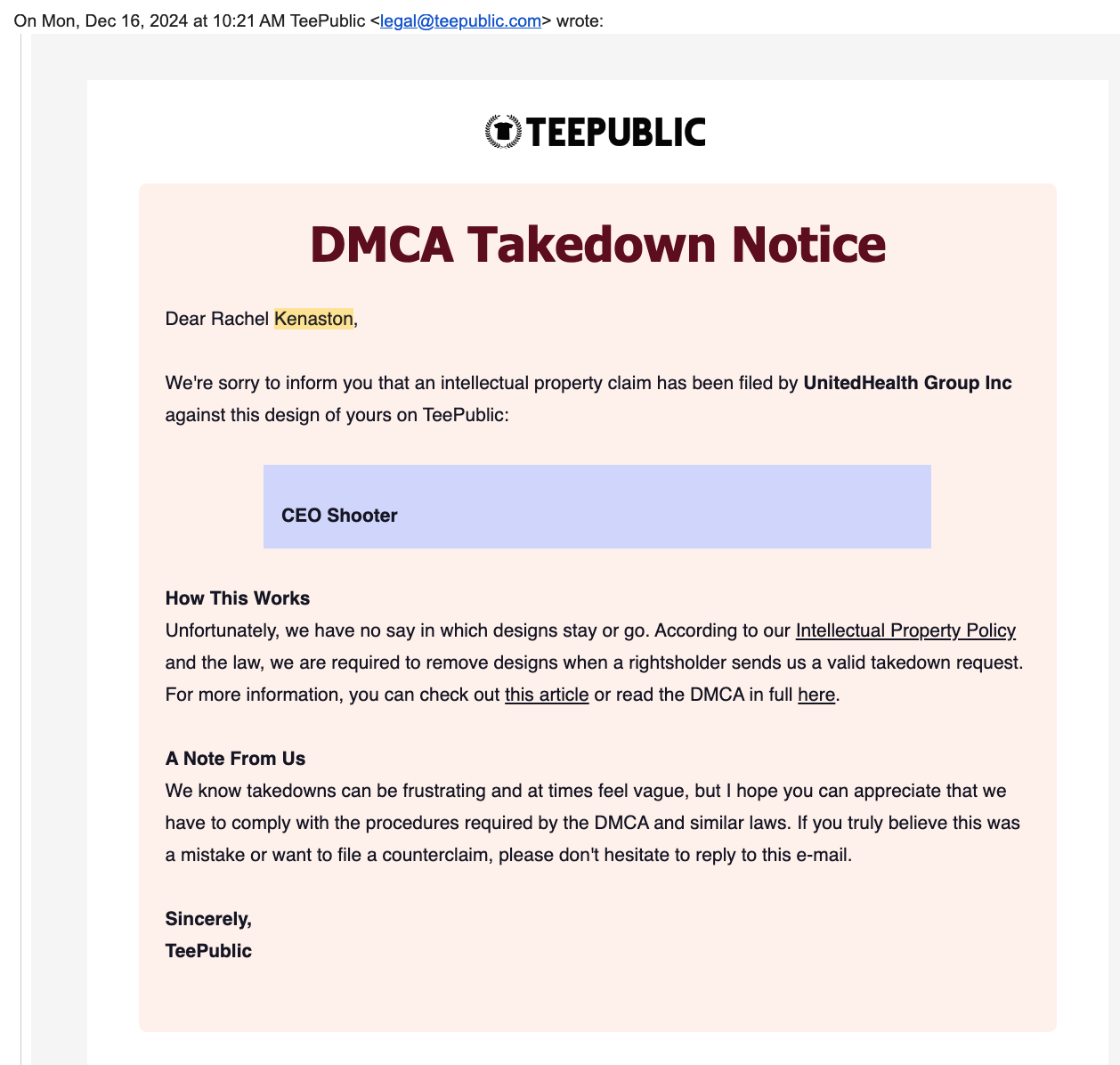
I had seen this story before Christmas making the rounds on Bluesky, claiming that United Healthcare had sent DMCA takedowns to Teepublic to remove artist Rachel Kenaston’s illustration of Luigi Magione, the guy arrested for shooting and killing United Healthcare CEO Brian Thompson.
While it does appear that Teepublic did, in fact, remove the image and claims to have received a DMCA notice from United Healthcare, I find it extremely unlikely that UHC actually sent a DMCA notice, given that they have no legitimate copyright claim over the image and enough lawyers who would know that. But we’ll get to that.
This case highlights a fundamental problem with the DMCA — it enables censorship by creating a system (backed by law) which allows anyone to demand content be removed from the internet with no real due process, putting heavy legal (governmental) pressure on companies to comply even if the claims are dubious. This arguably violates First Amendment rights by allowing the government to silence lawful speech.
While we can’t say definitively that UHC is abusing copyright law here, the fact that someone is able to do so in this case demonstrates the need to view copyright and the DMCA’s notice-and-takedown procedure in particular as a problematic tool for censorship.
404 Media got its hands on the actual email Kenaston received from Teepublic:
For reference, here is the removed image that Kenaston made:
It’s clearly an illustration based on the photo the NYPD released when attempting to identify Mangione, of him apparently smiling for someone working at the hostel he stayed at.
So, first off, obviously, the underlying image that the NYPD released would have extremely limited copyright protections which, if anything, would be assigned to the operator of the surveillance camera that took it. Kenaston’s illustration might also receive some fairly limited copyright protections for her artistic input.
But, obviously, none of that means that UHC would have any copyright interest at all. I doubt that UHC would have actually filed anything here, even if they don’t like the fact that a very large group of people appear to be supportive of Mangione. UHC have enough lawyers who understand IP law to know that this would be a totally bogus request. Of course there are many cases of companies sending such bogus requests, but those typically involve media operations or other IP-based companies, where unrelated content gets swept up by indiscriminate waves of takedowns (often through a third-party brand monitoring service). It seems similarly unlikely that UHC operates that kind of large DMCA takedown regime.
Also, TeePublic is misrepresenting the DMCA when it says it has no say in what stays on the site, or that it is “required” to remove the content. That’s simply false. The law does not require it, though it does create strong incentives for removal, by offering up a liability safe harbor for those that do remove. But companies are free to reject takedown notices if they don’t believe they are legit. It’s just that they might have to later defend that decision in court.
For what it’s worth, Teepublic is owned by RedBubble, and RedBubble has been taken to court many times over bogus claims of infringement. Indeed, I was an expert witness for them in past cases, so I know that the company has lawyers on staff who know full well that they can push back against bogus takedown claims. But also, I recognize that having fought out some expensive cases in court, they may take a much more “just pull it down so we don’t have to pay more lawyers” approach.
Going through the Lumen Database for takedowns using the Luigi Mangione name, I see that there are a bunch. Though, many of them seem to be people who made other stylized designs of Mangione and are mad that others have put them on t-shirts and hoodies. I question how many of the senders have significant copyright claims in designs like the following:
As we’ve been pointing out for decades, copyright is one of the very few tools in the toolbox that allows anyone to legally demand content be removed from the internet, and companies feel strongly compelled to do so.
Whether or not UHC is actually abusing copyright law this way, it’s clear that someone out there is, and that’s a very problematic feature of copyright law. The assumption that anything listed in a takedown notice is infringing, and the corresponding heavy-handed pressure to remove the content or face huge potential penalties, again reminds us why the DMCA is very questionable on First Amendment grounds.
The fact that someone is abusing it in this particular case is just a reminder of that, even if it’s not actually UHC doing the abusing.
Terms of Service are a reality we deal with all the time with digital goods and services. And by “deal with”, I mostly mean we don’t read them and simply agree to whatever they say instead, assuming there is nothing crazy in them. But that also causes a lot of problems, with customers of these products suddenly having changes to them foisted upon them, or realizing that they can’t do with their purchase what they thought they could, all of which are covered by the ToS that was essentially unread.
As a result, there are some folks out there who like to dive into the ToS for targeted industries. YouTuber Miss Krystle’s channel, Top Music Attorney, is one example of this. She is an attorney and musical artist who dives into Terms of Service within the music industry, analyzing them and pulling out anything that would be of interest or concern to a customer of the product or service. For instance, she covered the ToS for Splice, which provides a catalogue of royalty-free music samples for musicians to use.
“I have a series where I go through the terms of service for these music businesses, and I tell you guys what these contracts say that you’re being forced to sign in order to use these platforms,” she explains.
Krystle claims she was handed a cease and desist order from Splice’s legal department, to which she suggested jumping on a phone call to clarify some of the stipulations of the company’s ToS, saying she wanted to create a followup video for her audience’s clarity.
She says the call was productive and that Splice had agreed to update its ToS to iron out flagged inconsistencies, and that she left feeling a positive resolution was had by all.
So far, this whole thing reads as annoying but not terribly surprising. Splice’s legal team likely came across Miss Krystle’s video and, because ToS are somehow afforded copyright protection, sent out a C&D claiming the reproduction of those ToS in her YouTube video was infringing. Again, Miss Krystle is an attorney, so I imagine the call she had with Splice included explaining how this use is likely to be covered under fair use provisions. After all, it’s not as though she were using Splice’s ToS to copy it for her own ToS, which is where copyright claims for Terms of Service tend to come from. In any case, she indicates the call ended on a positive note.
And then Splice issued a copyright strike against her channel.
It was only the next day that she discovered her Top Music Attorney YouTube channel had been issued a copyright infringement takedown notice at the request of Splice, resulting in a harmful copyright strike. If a YouTube user receives three copyright strikes in 90 days, their account and channel is permanently terminated.
And now Splice has a problem. For starters, the original video Splice complained about is still up on her channel. And because of both the C&D and moreso because of the copyright strike, a whole lot more attention is being paid to that original video, Miss Krystle’s follow up video in which she tells the story of the C&D and getting the copyright strike, and the issues surrounding Splice’s ToS as a whole. You have to assume that Splice took these actions because it wanted to limit the content of these videos’ critiques of its ToS from as much public attention as it could. In true Streisand Effect fashion, it achieved the exact opposite.
Which brings me to the question that everyone should be asking: just what is in these Terms of Service that Splice is so terrified its customers and potential customers will see?
Fortunately, a lot more people can get the answer to that question from Miss Krystle, all because Splice wanted to try to silence a critic to keep them hidden.
Welp, sometimes you gotta read BestNetTech fast, or you just might miss something. And sometimes it’s because Universal Music is acting to silence creativity yet again. Yesterday, we posted about how Dustin Ballard, the creative genius behind There I Ruined It, who makes very funny parody songs, had posted a lengthy disclaimer on his latest YouTube upload.
The video was the Beach Boys covering Jay-Z’s 99 Problems where every bit of it (minus the lyrics) sounded like a classic Beach Boys song. What made it interesting to us at BestNetTech was the long and convoluted explanation that was included in the video to explain that the song is parody fair use, which is supposed to be allowed under copyright law.
But, sometime after that story got posted, Universal Music stepped in and decided to ruin the fun, in the only way Universal Music knows how to act: by being a copyright bully where it has no need or right to be.
Now, this is likely an automated copyright claim using ContentID or something similar, rather than a full DMCA takedown. But, it’s bullshit either way. Universal Music knows full well that it’s supposed to take fair use into account before issuing a copyright claim. Remember, Universal Music lost a lawsuit over its bogus copyright claims where it was told that it had to take fair use into account before sending such claims.
But, alas, none of that matters the way the system works today. It’s more important for YouTube to keep Universal Music happy rather than the content creators on YouTube or people who want to enjoy this music.
I’m almost hesitant to point this out, for fear that some asshole at Universal Music will read this and continue on their warpath of culture destruction, but you can still hear versions of the Beach Boys doing 99 problems at both Instagram and TikTok (I mean, at least until TikTok is banned). The versions on those two sites are a bit shorter than the full YouTube version. They also cut off the copyright disclaimer such that it’s shorter.
But, really, this is yet another example of how totally broken the copyright system is. There is no conceivable reason for removing this. It’s not taking anything. It’s not making the Beach Boys or Jay-Z lose any money (and, ditto for Universal Music). If anything, it’s making people more interested in the underlying songs and artists (no one is interested in fucking Universal Music, though).
Fair use is supposed to be the valve by which the copyright system doesn’t violate the First Amendment. But when we see copyright wielded as a censorial weapon like this, with no real recourse for the artist, it should raise serious questions about why we allow copyright to act this way in the first place.
Almost exactly two years ago, we discussed a strange story in which video game publisher Bungie sued a bunch of John Does specifically for inputting fraudulent DMCA takedown claims on YouTube videos that contained Bungie content. Those notices purported to be from Bungie in some cases, but even Bungie’s own YouTube channel was hit by some of them as well. Later on, Bungie unmasked one of the Does as YouTuber Lord Nazo, real name Nicholas Minor, as one of the perpetrators of these takedown notices. In those discussions, we mentioned that while Bungie will come out looking like the good guy here if its claims were correct, the real story here is just how wide open for abuse YouTube’s DMCA takedown process is.
In a dramatic turn of events, the legal battle between gaming giant Bungie Inc. and online gamer Nicholas Minor, famously known as Lord Nazo, has reached a surprising conclusion. After accusations of false copyright infringement, the two parties have finally settled, bringing an end to the intense courtroom drama that has captivated the gaming community.
During the legal proceedings, Minor admitted to creating a phony email address and submitting the video removal requests. His actions were reportedly motivated by a desire to highlight the lack of transparency in YouTube’s takedown process, following the removal of one of his own videos. This revelation added a layer of complexity to the case, shedding light on the broader issues surrounding online content moderation.
Minor’s actions can’t be justified by this motivation, of course, but it’s hard to argue he didn’t effectively make his point with all of this. Sure, he got caught and ostensibly is going to suffer some measure of punishment for his actions, but that’s because Bungie was his target and Bungie has the resources to force this sort of action. Think about all the other individual or smaller entities out there that suffer from these same fraudulent-type actions that don’t have the resources to fight back, or don’t want to bother doing so. In those cases the bad actors get away with their bad actions and none of us ever even hear about it.
Even for those larger entities, navigating all of this isn’t easy.
Bungie’s lawsuit underscored the challenges faced by content creators and gaming companies in navigating the intricacies of copyright law and online platforms’ policies. The false infringement complaints not only disrupted Bungie’s community of online gamers but also prompted a reevaluation of YouTube’s takedown procedures. The resolution of this case may set a precedent for future disputes involving copyright infringement and online content moderation.
And to its credit, Bungie said at the start of its legal action that YouTube’s DMCA process doesn’t sufficiently protect for this kind of fraudulent behavior. I have yet to hear of any massive changes made by YouTube as a result of this instance and others like it.
So for today, the status quo remains. But it certainly shouldn’t long term.
On Monday, I saw Elon Musk tweet the following, and initially thought that he might have actually made a good policy decision for once, and planned to write up something about Elon doing something right (contrary to the opinion of some, I’m happy to give him credit when it’s due):
Punching back against DMCA abusers is a good policy (and one that the old Twitter was willing to go to court over — though very early Twitter was less good about it). So, in theory, suspending accounts of those who engage in “repeated, egregious weaponization” of the DMCA seems like a good policy and Musk should be given kudos if that’s how the policy is actually put into operation.
Though, the actual details here are kind of a mess, and it’s possible that instead of putting in place a good policy, Musk might have (instead!) opened up Twitter to potentially massive liability.
This came about over a dispute between two Twitter users, but the details are now gone, as Twitter suspended one account, and it appears the other account deleted all the tweets about this dispute (though I’ve been able to dig up a few screenshots).
One account, @Rainmaker1973, is one of thousands of aggregator accounts that basically find other people’s content and post a constant stream of it to their feed. Rainmaker has 1 million followers, so is a pretty large account. Looking over Rainmaker’s feed, you can see that the account links to source material (through tracked buff.ly links). When it’s posting videos, it appears to embed the original video, rather than re-uploading it, though the way Twitter handles that is sometimes a little confusing. It just puts a little “from @OriginalAccount” in small letters underneath the video, with a link to that account’s profile page, but not to the tweet where the original video was. I’ve never quite understood why Twitter handles video embeds this way, but it does. Here’s one example, with the Twitter-appended attribution highlighted:
For photos, that’s not how it works. You basically have to reuse the photos (and if they’re hosted somewhere else, upload them to Twitter). That’s what the Rainmaker account did here, with a photo that originated on Facebook:
Is that infringing? Eh… I’d say that the Rainmaker account has pretty strong fair use claims much of the time. The account also appears to lean towards public domain images (such as from NASA) and some Creative Commons-licensed images. But fair use is always fact-specific, so it’s difficult to say if none of the accounts tweets might violate copyright law.
What appears to have happened, based on what many others have written, is that the Rainmaker account posted a video from another account, @NightLights_AM, that specialized in images and videos of the northern lights. While these tweets have since been deleted, note that the video in the image does not show the little “from” line, as it would if it were embedded directly from Twitter.
Now, unfortunately, since it’s all deleted, we can’t see exactly how the video is embedded. Rainmaker says it’s embedded, not uploaded. It doesn’t have the “from” line at the bottom in that screenshot, but… it might still be from a Twitter embed, because Twitter (confusingly!) does not show that “from” line in the video if it’s being quote tweeted, as is the case here.
So, based on all that, there’s a decent chance that the DMCA notice was somewhat iffy. I recognize that lots of people don’t like aggregators like the Rainmaker account, but if he’s just using an existing upload from the official account as an embed, then it’s clearly not actually infringing.
It is quite possible, though, that most people don’t understand how video embeds of other Twitter videos work on Twitter (it’s confusing!), and so it wouldn’t surprise me if the NightLights account didn’t even realize it was an embed of the original, and out of frustrating of this large aggregator account getting all the traffic for its video, sent a good faith (but mistaken) DMCA notice.
In the now-deleted tweet you see above, the Rainmaker account says it reached out to the NightLights account, and NightLights asked for money (likely for a license). Again, assuming Rainmaker was just embedding, there is no need for a license. It’s literally just using Twitter in the way it was intended, and in a manner that NightLights already granted a license for. Somewhat confusingly, in a later tweet, the Rainmaker account claims that NightLights didn’t actually want money and instead said that NightLights was trying to shut down his account:
For what it’s worth, the guy behind NightLights told TorrentFreak that Rainmaker is misrepresenting their conversation, and that it was Rainmaker who first proposed paying, if NightLights would rescind the DMCA notice:
Mauduit informs TorrentFreak that after sending the DMCA notice to Twitter, Massimo initiated contact and suggested that he should pay an amount to have the report retracted “since the situation for him was so dire.”
Mauduit says that since the offer came Massimo, that doesn’t constitute blackmail. A few hours later Massimo accused Mauduit of blackmail on Twitter, Mauduit says.
“I asked him to compensate me fairly for the use of the material. So at that point, that was purely business related and politically correct,” Mauduit says.
Either way, Twitter’s head of trust and safety quickly told the Rainmaker account that, despite his fears, the company would not suspend his account:
This is also a good policy (so kudos to Irwin and Musk on continuing this aspect of old Twitter’s policies). She also noted in another tweet that the Rainmaker account “is not at any risk for suspension.”
Of course, “pirating / egregious illegal behavior” is somewhat in the eye of the beholder. And so is… “blackmail.” Yet, about an hour after Ella’s tweets, Musk himself noticed Rainmaker’s tweets and announced that he would “suspend” accounts for “blackmail.”
Again, in a vacuum, this could be good policy. Suspending egregious copyfraudsters who abuse copyright to shake people down or silence them makes sense. And DMCA abuse for extortionate behavior does happen unfortunately often. As does abusing the DMCA to silence others over non-infringing speech. We’ve covered many, many such cases over the years.
So, having a policy that pushes back on that abuse of copyright law is good —and another nice thing you can say about Elon Musk is that he’s been quite good about recognizing the problems associated with patent and copyright law. Other companies have pushed back on copyright abuses as well, such as how Automattic (the company behind WordPress, and also the company that hosts BestNetTech) has spent years fighting back against DMCA abusers. But it has a clear process for doing so, rather than the whims of an impulsive owner.
In this case, though, Elon appeared to take Rainmaker’s (slightly confused) word for what happened, and flat out suspended (temporarily) NightLights for what appears to have been a good faith DMCA notice, followed by a discussion initiated by Rainmaker regarding payment.
As I was finishing up this article, the NightLights account was actually reinstated, though the guy says he’s now considering leaving the platform:
So, given all this, the concept behind the policy is good, but there’s not much evidence that NightLights was actually actually “blackmailing” Rainmaker. From what was public (and mostly now deleted), it looks more like the account mistakenly thought that its content was used in an infringing manner due, in part, to Twitter’s own confusing presentation of embedded videos, and filed a good faith, but mistaken, DMCA notice. When Rainmaker contacted NightLights to try to get the DMCA strike removed (out of a fear that it would take down the account), the began a discussion on a licensing fee, which again seems reasonable if NightLights actually thought the use was infringing.
Also, this seems to have no angered others who were fans of the NightLights account:
Once again, content moderation at scale is impossible to do well because people are going to be mad at you on both sides of the equation.
In the end, this looks like a lot of miscommunication across the board, in part from people who aren’t fully aware of how Twitter or copyright law actually work. The end policy — don’t put up with shit from those who abuse the DMCA process — is actually great. But it really doesn’t look like NightLights was abusing the DMCA, just confused about how Twitter worked.
And because of the somewhat less-than-well-considered way in which Twitter under Elon is acting, if NightLights had a legitimate claim (and again, I don’t think it does in this case), quickly suspending an account for filing a real DMCA claim could open up Elon and Twitter to pretty significant liability. Contrary to popular belief, companies that receive a DMCA notice do not need to take down the content. But if they don’t, they can no longer use the DMCA’s 512(c) safe harbor, which is a risk if the case went to court. So refusing to take down something upon notice is a legal risk, and the kind of thing a large company like Twitter would normally have a copyright lawyer review.
The other potential issue is that if Twitter makes it a habit to suspend accounts that send good faith or legitimate DMCA notices, it could very much open them up to claims that they do not have a valid “repeat infringer” policy, as required by 512(i). Suspending one account for sending a good faith DMCA almost certainly won’t trigger that issue, but having Elon flat out say that Rainmaker’s account “won’t be” suspended could be read to mean that Twitter is ignoring its repeat infringer policy with regards to at least that account. And, I could see copyright lawyers trying to argue that this is an example of how Musk is willing to ditch the 512(i) policy for accounts he likes. At the very least, you can bet that these kinds of impulsive policy decisions will be used in court by copyright litigants. Perhaps from Hollywood studios who noticed that, last fall, amidst all the turmoil, Elon’s Twitter seemed to be ignoring many DMCA notices about accounts posting entire Hollywood movies.
In short, impulsive decisions around DMCA policy, made without first going over things with an actual copyright lawyer, can open up a company like Twitter to quite a bit of liability. But this is the Elon Era, in which YOLO seems to be the general ethos, and if it happens to add to yet more legal liability? Well, just toss it on the pile.
For years, companies have been offering questionable services to downrank and bury information their customers don’t want surfacing during Google searches. And for years, these tactics have routinely involved abuse of copyright law, forged/faked court orders, and the filing of bogus lawsuits in hopes of securing default judgments from inattentive judges.
This is more of the same. Documents leaked to Forbidden Stories and shared with the Washington Post have uncovered the unsavory tactics (and even more unsavory customers) of Eliminalia, a Spain-based reputation management company with one hell of an origin story. This is from the Washington Post’s extensive report on the leaked documents, which details how Eliminalia founder Diego “Didac” Sanchez came to believe this company must exist:
When he was 12, he accused a local businessman of molesting him multiple times. The man was convicted of sexual abuse in a highly publicized trial and was imprisoned in 2007.
Years later, as a teenager, Sánchez publicly recanted his story, saying he had made it up. A panel of judges declined to overturn the conviction, however, citing additional evidence in the case, court records show.
Sánchez got news accounts of the abuse allegations removed from the internet, he wrote in the autobiography. He did not say how he did it, or what specifically was removed, but he wrote that he recognized a business opportunity.
Nothing in the documents suggests Sanchez decided to go into an extortion-like business by drumming up nasty allegations and making victims pay to have them removed from the internet. But that set of paragraphs sure seems to suggest it might have been a viable option.
Eliminalia does not seem to engage in any overt criminal activities. Instead, it appears to engage in a bunch of dishonest tactics. These tactics include creating fake sites to host (and backdate) copied content so the original could be targeted with bogus copyright claims. Here’s how this tactic works, as described in the Forbidden Stories article, which details interactions between a targeted publisher of critical journalism (Mexican reporter Daniel Sanchez) and the bogus persona concocted by Eliminalia (Humberto Herrera Rincon Gallardo) to get the content removed.
In January 2020, Gallardo filed a claim with Digital Ocean, Pagina 66’s US-based hosting provider, alleging that Sánchez had copied his content illegally. As proof, Gallardo linked to a third-party site that had published a replica of Sánchez’s piece, but with a falsified earlier publish date and fake author: Humberto Herrera Rincón Gallardo.
This time, the strategy worked. Digital Ocean ordered Sánchez to remove his article from Página 66’s site, or it would go black.
That was the tactic Eliminalia chose to go with after impersonating the EU Commission with a bogus takedown letter claiming GDPR violations: committing apparent perjury by faking up a copyright complaint.
Eliminalia also creates bogus news sites by the dozens, flooding the internet with low-value posts supposedly written by people who want worse content written about them buried.
Researchers from Qurium linked the 600 fake news websites to Eliminalia’s parent company, Maidan Holding, according to Tord Lundstrom, Qurium’s technical director. The websites’ IP addresses — each a string of numbers identifying where a site is hosted — are clustered together sequentially, Lundstrom said, and registration data from the websites’ hosting providers show that the IP addresses were assigned to Maidan.
The fake news sites contain real news copied from legitimate media organizations, and many have names that are similar to real outlets — the London New Times, CNNEWS Today and Le Monde France. But tucked amid those headlines are at least 3,800 articles that prominently feature the names of customers identified in the Eliminalia records…
So, the sort of stuff we’ve seen before, only on a much more massive and, apparently, lucrative scale. But given the company’s origins — a man trying to right a wrong he’d caused by wiping the internet of his false molestation accusation — Eliminalia seems more than willing to help far less altruistic people cover up evidence of their wrongdoing.
Its U.S. clients included a popular reality-TV personality publicly accused of sexual misconduct and a California biotech entrepreneur who had been convicted of financial fraud and is now fighting charges he hired a hit man to kill a business associate. The leader of a major religious charity in Chicago that faced criticism over its executives’ salaries also turned to Eliminalia, the records show.
Eliminalia did work for an Italian spyware company that had been fined for selling surveillance technology to Syria’s autocratic regime, and for a Swiss bank that had drawn public scrutiny over Venezuelan clients who were suspected of money laundering. It also worked on behalf of a well-known traveling circus clown who had been convicted of sexually assaulting a 14-year-old girl in Switzerland.
Here’s more, from Forbidden Stories’ reporting:
Forbidden Stories identified Eliminalia clients in 50 countries across five continents. The leak of around 1,500 current and former clients includes details of Eliminalia’s business dealings with a medical doctor who reportedly operated a torture center during Chile’s dictatorship and was found guilty of homicide; former bank officials at Banca Privada d’Andorra, accused of money laundering for corrupt Venezuelan officials; and a Brazilian businessman implicated in a global prostitution network, among others.
And now that this has been exposed by the documents and the great reporting at both of the above-mentioned sites, Eliminalia is attempting a disappearing act of its own. Reporters visiting its Barcelona office were informed it was now a company called “Idata Protection,” a (you guessed it) data protection service in no way affiliated with the work performed by the entity that owns it, Eliminalia. Its founder was also nowhere to be found.
Ugly tactics and even uglier customers. That’s not surprising. The entities that tend to seek out reputation management help are those that have destroyed theirs by being awful. For a little while, dodgy takedowns and black hat tactics actually get the job done. Sooner or later, though, it almost always seems to fall apart. But just as much as disintegration is inevitable, so is the rise of another company just as awful to take its place.
It should come as no surprise to regular BestNetTech readers that the DMCA takedown process is not only wide open to fraud and abuse, but that those avenues are regularly used in real life for just those purposes. Takedowns to silence criticism, takedowns to try to steal traffic from others, or takedowns or monetization claims just to get some paltry amounts of streaming revenue: the point is that this shit happens all the time. What absolutely does not happen with any frequency is the folks behind these bogus actions getting punished in any way for their behavior.
And so when it does happen, it’s worth highlighting it, putting it on a podium, and trying to have it become the norm rather than the exception. To that end, let’s highlight YouTube actually banning an account that appeared to be sending fraudulent DMCA notices.
Yesterday, the owner of the “Musical Creator” channel complained that their channel had been terminated after submitting a copyright takedown request. The operator of the channel doesn’t appear to be a native English speaker as the comment below shows, but it’s clear that they disagree with this decision.
“My youtube channel MUSICAL CREATOR has been terminated due to inlegal information copyright infringement. But I not violating any policy of youtube, I don’t know how my channel is terminated I filled out all the information legal. I want to get back my channel again,” the operator writes.
Now, a couple of things to say here. First, the channel’s name is “MUSICAL CREATOR”? Hmm, okay, totally doesn’t sound like the kind of thing you would create just to send DMCA notices and try to monetize others’ content. And we don’t have any details from YouTube as to what specifically was the issue with whatever takedown notice MUSICAL CREATOR sent. Instead, all we have is this from YouTube’s notice directly.
“We are concerned that some of the information within this legal request may be fraudulent,” YouTube’s response reads. “Please understand that YouTube receives a large number of fraudulent copyright takedown requests, and we take abuse of that process very seriously.”
While that doesn’t tell us much or let us vet out whether fraud was actually committed or not, it’s worth keeping in mind again that YouTube takes very little action on this sort of thing generally speaking. By which I mean that the fact it took action in this case leads me to believe YouTube thinks it’s on very, very solid footing here.
As a result, the MUSICAL CREATOR account is down. Anyone going to its page is simply told that the account is offline due to “a violation of YouTube’s Terms of Service.”
Again, it’s hard to be completely assured that YouTube’s actions in this case are appropriate… but I suspect they are. And, purely as a matter of percentage cases, the fact is that YouTube and other platforms have historically been so vastly on the side of those issuing DMCA notices instead of the potential victims of fraud that it makes stories like this unique.
It was only a week or so ago that we discussed the latest example of the type of fake DMCA notices that Google gets to delist certain URLs from search results. In this instance, a couple of factors made these DMCA notices even more problematic than usual. For starters, they claim to be coming from the U.S. Copyright Office, which very much does not send in DMCA notices like this. On top of that, the notices claim they are being sent by the U.S. Copyright Office on behalf of the Video Industry Association of America which, as I noted in my original post, doesn’t seem to actually exist. Finally, and perhaps most importantly, these are notices for Section 1201 claims, which deal with anti-circumvention aspects of copyright law, that target mostly stream-ripping sites and sites that cover or guide legit uses of those sites. Notably, Google does not have an appeal process for 1201 notices, leaving anyone who got delisted basically screwed.
Well, now the mystery somewhat deepens. The Section 1201 DMCA notices have continued to flood Google, but now they are being supposedly sent directly by the Video Industry Association of America, with whoever is sending these dropping the pretense that they’re coming from the US Copyright Office. But that isn’t actually clearing much up other than to highlight, again, that the organization doesn’t actually exist and is coming from Russia.
A mysterious group called the ‘Video Industry Association of America’ is trying to wipe the homepages of dozens of reputable sites from Google search. The targets, which stand accused of violating the DMCA’s anti-circumvention policy, include Verizon, Pinterest, and Engadget. Google says that it’s aware of these fraudulent notices but, thus far, they are not without damage.
The ‘American’ organization starts one request off in Russian and finds it hard to construct proper English sentences. In another notice, it complains of sites and apps that circumvent the copyright protection of streaming services, while classifying these as “software cracks.” Things get even more problematic when we look at the URLs that are reported. While these include tools such as DVDFab and YouTube-rippers, which some rightsholders see as problematic, various legitimate sites are targeted as well.
So what’s going on here? Well, it seems that whoever is behind these DMCA notices is taking shotgun approach to them. Anything that has to do with providing or informing the public on matters of stream-ripping, legit or otherwise, are being targeted. Plenty of other tech news organizations have been targeted as well, such as Engadget and CNET. Most of the takedown requests have gone ignored by Google, but several have not. Many smaller tech sites have been delisted as a result of all this.
For at least one of the sites, Google has acknowledged that the delist request was not legit, but also said there is no current appeals process.
Fossbytes reported the issue to Google, which informed the site that there is no official counter-notification process for these anti-circumvention takedowns. As such, the URLs remain deindexed for now.
“There is no formal counter notification process available under US law for circumvention, so we have not reinstated these URLs,” Google replied, requesting a detailed explanation from the site.
Meaning the onus is still on the victims of this crap to get themselves re-listed. And, once TorrentFreak got its hands on a copy of the takedown request, it illuminates how blatantly fraudulent all of this is.
This reveals some interesting details that are not available in the Lumen database, including the name, email address, and geolocation of the ‘Video Industry Association of America’ representative.
As can be seen above, the sender is actually located in Russia and identifies itself as “Wolf Fang,” which isn’t a typical name, not even in Russia. The email address, which we won’t publish, comes from Gmail and references another animal’s fangs.
Again, what’s going on here? Is this some coordinated Russian effort to delist a bunch of prominent or otherwise American news sites? Not likely. Instead, this is more likely a form of the kind of fraud-based attack we’ve seen from overseas sites that abuse the DMCA process in order to take down both its competitors and references to competitors wherever possible.
For now, it remains a mystery who’s behind these notices. It wouldn’t surprise us if the “Video Industry Association of America’ is actually a direct competitor of the stream-ripping and DRM circumvention tools that are reported.
This is a strategy we have seen several times in the past. A competitor targets URLs from competing apps and sites, so their own site will end up higher in Google’s search results.
In other words, the only real good these bullshit DMCA notices are doing is to further highlight the wide open avenues for fraud and abuse in our current DMCA takedown process.
We have seen and covered a great many ridiculous copyright issues here at BestNetTech. It is, after all, sort of our thing. Still, some attempts at enforcing copyrights are so ludicrous that they take your breath away. Now, granted, often times the most egregious of these stories arise out of the use of automated bot systems that troll all the places for copyright infringement and often times get it completely wrong. But that isn’t so much an excuse for those situations as it is a spotlight on how brutally terrible the current iteration of copyright enforcement has become and how despicable it is that the wider copyright industries just shrug their shoulders at all the collateral damage they cause.
And then there’s the moon. I know, I know, you’re thinking, “The moon? Is Timothy having another stroke while writing a post?” First off, my personal health is none of your concern. And secondly, nope, because a video recording of the moon as seen from Greece, which included no audio, was blocked all over the place due to a copyright claim made by Universal Music Group.
British filmmaker Philip Bloom recently filmed the Moon during sunset Skiathos in Greece. After sharing it on social media, he was surprised when the video was blocked due to a claim by Universal Music Group, which claimed copyright to the generic shots of the Moon. Here’s the audio-less video that Bloom shared to his personal Facebook account while on his holiday:
Yup, that’s it. So, how did this get flagged for copyright by UMG? Well, according to the block notification, UMG says the video contains “30 seconds of video owned by UMG”. How? Well, who the hell knows. If I had to guess, I would speculate that there is some music video out there or something that also contains footage of the moon and that somehow has resulted in an automated system flagging this video of the moon as copyrighted content.
But, just so everyone is clear, UMG does not actually own footage of our nearest celestial neighbor. The person who filmed the footage, filmmaker Philip Bloom, is understandably not pleased.
“I uploaded some shots of the moon to Facebook late last year shot with the Canon R5 but it was a 2/3rds moon,” Bloom tells PetaPixel. “It looks like their AI is looking for full moon shots.”
Bloom then filed a dispute against the copyright infringement block, explaining to Facebook: “It’s a shot of the moon I personally filmed tonight!!! UMG doesn’t own the moon!”
But because, again, the way copyrights are enforced currently is a goddamned nightmare, the footage is still offline for those social media channels in all those countries while Bloom is going through the appeals process. And it’s very much worth considering that this isn’t an isolated case, either.
Bloom says that after he shared about what happened on social media, one of his followers shared that the exact same thing happened to them.
And so here we are. During the appeals process for Facebook at least, it appears that the assumed state of things is such that UMG owns the copyright on footage of the moon. If the fact that the setup of the DMCA and our enforcement of it allows this result makes any sense at all to you, then perhaps you’d be better off living on UMG’s moon.