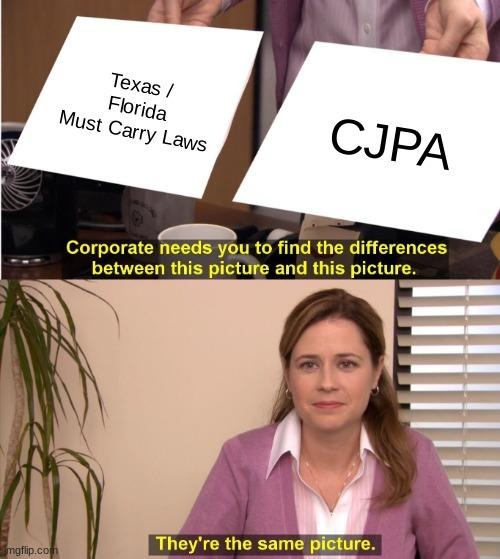
This year, California brought back an old proposal for a link tax from state Rep. Buffy Wicks, along with a separate proposal from state Senator Steve Glazer to just tax the digital advertising business, claiming that it’s a form of pollution, and proposed using that tax to fund journalism.
While getting more funding for journalism is obviously a good idea, the plan to tax internet companies is tremendously problematic for all the reasons we discussed above. On top of everything else, it also takes away the incentive for media orgs to come up with sustainable, working business models for themselves, encouraging them, instead, to wait until the legislature deigns to force tech companies to funnel money in their direction.
As almost always happens whenever these kinds of bills get close to passing, Meta promises to stop links to news (and mostly seems to follow through). Meanwhile, Google says it will do so, but then blinks and cuts a deal to pay off everyone, such that even if the law passes, they have already paid the vig. Google did it in Australia, and it did it in Canada. Both times it agreed to cough up a bunch of money. And even though in both countries a link tax came into effect, both payments were made outside of the link tax, and basically acted as a “here, take this money, don’t try to enforce the link tax on us” move.
This time, it looks like Google made the payoff earlier, to stop the law in California. A few weeks back, Wicks announced that her office and Google had come to an agreement to fund a bunch of journalism orgs with money from both Google and the state, and that she wouldn’t continue pushing her link tax bill.
Today, Assemblymember Buffy Wicks announced the establishment of a first-in-the-nation partnership with the State, news publishers, major tech companies and philanthropy, unveiling a pair of multi-year initiatives to provide ongoing financial support to newsrooms across California and launch a National AI Accelerator.
Together, these new partnerships will provide nearly $250 million in public and private funding over the next five years, with the majority of funding going to newsrooms. The goal is to front-load $100 million in the first year to kick-start the efforts. The total investment could increase over the next several years if additional funding from private or state sources becomes available.
That link has a lot of people coming out in support of the deal, including some smaller publishers, claiming that this is “a win” for everyone. However, I doubt that very much.
But, more to the point, the whole appearance of this is ridiculous. It looks like Google paying the state of California to not pass the link tax law, with a bunch of that money then being handed off to some journalists. It’s very unclear at this point how the money will be distributed, but I’m going to take a wild guess and suggest that sites like BestNetTech will likely be ineligible, because we always are.
More importantly, though, these kinds of deals never last. A few years back, you may recall that a very rich real estate developer with no understanding of privacy law pushed a very bad privacy law as a referendum across California. The companies cut a deal with him, rushing a very poorly drafted privacy bill through the California legislature in exchange for him dropping the ballot initiative. And it worked. For two years. Then he put another terrible referendum back on the ballot because he didn’t like how things were working out.
Already, Glazer (the author of the “tax all digital advertising” bill) is complaining about the deal, suggesting he’s not likely to stop pushing his additional tax bill.
Glazer in a media call said he wasn’t satisfied with the deal and faulted the agreement as too small to help independent news organizations, as well as lacking involvement from Meta or Amazon.com Inc. Meta declined to comment on the announcement, according to a spokesperson.
“These platforms, along with Google, have captured the intimate data from Californians without paying for it,” he said. “The use of that data in advertising is the harm to news outlets that this agreement should mitigate and which it does not.”
So even if Google thought it was buying off the legislature here to drop these bills, it seems highly likely that something like this will return either way, because it’s never going to be “enough.”
Again, I’m strongly in favor of figuring out more and better ways to fund journalism. But this one comes across as a cynical attempt to stop a bad law by investing in a fund with few details on how or where that fund will be deployed. It seems ripe for corruption, and even journalists who are in favor of link taxes are calling it out as an unfair backroom deal.
The problem in all of this is that people are rushing to see where they can extract money from to transfer it around, rather than figuring out ways to build actual long-term, sustainable business models that aren’t reliant on politicians pointing to this or that company and saying “you, hand over some money to these journalists I like.”
That thing is happening again, where politicians are pushing a bad law that will benefit Rupert Murdoch, while harming the public. Rather than blaming Murdoch or the politicians pushing the law, they’re blaming “big tech” for actually responding to the law accordingly. Because that’s easier. But it’s wrong.
In this case, it’s California’s terrible attempt at a link tax, pushed for by Assemblymember Buffy Wicks. Google is experimenting with removing links to California news publications for California news users, which is exactly what the law demands. But, lots of people are getting mad at Google, when they should be mad at Wicks.
Let’s take a step back to the beginning.
Link taxes are bad, mmkay?
The entire concept is broken and represents an attack on the open internet. They have not worked, contrary to what supporters will tell you. In Australia, often held up as the shining example of link taxes working, smaller publications are laying off journalists and shutting down at a faster pace than before.
If you don’t follow this closely, link taxes are a horrible idea. They were cooked up by Rupert Murdoch because he was mad that his internet ventures were flopping, while Google and Facebook were thriving. The famed faux-free market supporter insisted that if Google and Facebook were making money while he was struggling, it must be because of something “unfair” that they had done: namely become a source that people go to to find links to news stories.
Somehow, Murdoch and friends spun this as “stealing” the news. Except, it’s not. It’s literally linking to news sites and sending traffic to them. And the news orgs clearly value that traffic, because they not only do not block such traffic (which would be easy to do with robots.txt and referral blockers), they actually hire “search engine optimization” and “social media marketing” teams to make sure they appear more often on Google and Facebook.
So, what Murdoch wants is not just for Google and Facebook to send free traffic his way, but actually for them to pay to send him traffic. That is literally all that these “news bargaining codes” are. They are direct wealth transfers, facilitated by politicians, from internet companies that are making money (Google/Meta) to media companies that are also (mostly) making money, but are mad that Google and Meta are successful.
Even if you believe that we need more sustainable options for journalism (and, as a journalist, I believe that very strongly), everything about link taxes is corrupt. It’s a direct, government-mandated, wealth transfer from one industry to another industry. It’s an out-and-out favor to the news industry (which the political class often relies on for election endorsements). It effectively takes money from one industry and hands it to another for doing nothing more than helping news sites get more traffic and distribution for free.
Meta has been much stronger than Google in standing up to these nonsense laws. Unfortunately, Google has caved in both Australia and Canada, while Meta has been more willing to push back.
As we’ve shared when other countries have considered similar proposals, the uncapped financial exposure created by CJPA would be unworkable. If enacted, CJPA in its current form would create a level of business uncertainty that no company could accept. To prepare for possible CJPA implications, we are beginning a short-term test for a small percentage of California users. The testing process involves removing links to California news websites, potentially covered by CJPA, to measure the impact of the legislation on our product experience. Until there’s clarity on California’s regulatory environment, we’re also pausing further investments in the California news ecosystem, including new partnerships through Google News Showcase, our product and licensing program for news organizations, and planned expansions of the Google News Initiative.
I’ve seen some people get mad at Google about this, just as people were mad at Meta when they did a similar thing in both Australia and Canada.
But that anger is misplaced: be mad at Rupert Murdoch, who would be the largest single beneficiary of the law by far. Be mad at California Assemblymember Buffy Wicks, who would be orchestrating this wealth transfer from companies that have employees in her district to Rupert Murdoch, and pretending this attack on the open web is somehow good for journalism.
Be mad at all the media companies that won’t report accurately on the problems of such a law because they so want in on this wealth transfer.
In the end, Google is doing exactly what the law suggests it should do. If the government taxes something, you get less of that thing. That’s a fairly fundamental economic concept. Here, the tax is ridiculously problematic because it’s (1) taxing something that should never be taxed: links on the open web, and (2) not a typical tax, but one where the monetary transfer goes directly from one industry to another. Either way, it remains a tax. And the end result of a tax is: less of what is being taxed. So, yes, if those links are taxed, there will be less links on Google and Meta to news sites.
And, obviously, this sucks for me as a California-based publication. But I don’t blame Google for doing what the law directly incentivizes. I blame Buffy Wicks for pushing an obviously flawed law, on a topic she clearly doesn’t understand, to please the local newspaper that endorsed her.
As we discussed last year, there’s historical precedent here. Richard Nixon passed a similar law in the 1970s, in exchange for newspaper endorsements. It hastened the collapse of local newspapers, but Nixon got his endorsements. Wicks seems similarly willing to sell out journalism in her state in order to get an endorsement. It won’t be good for smaller news publishers like ours. It won’t be good for the public. It won’t be good for the internet. But it will be good for Buffy Wicks and Rupert Murdoch.
To date, Canada’s Online News Act has been a total clusterfuck. Meta has made the reasonable business decision to no longer allow news to be posted to its websites, which has not reduced Meta’s traffic one bit, but has harmed Canadian news sites. As the Canadian news site FreezeNet recently noted, the officials who supported C-18 and insisted that everyone was lying when they pointed out these problems have now, themselves, taken to flat out lying about the law and its impact, falsely claiming that the bill has nothing to do with linking (even as officials have admitted that you only have to pay the tax if the companies allow links). They also seem to be living in a fantasy land, as pointed out by law professor Michael Geist (also a guest on our podcast about this bill):
That’s Geist noting:
Heritage Minister Pascale St-Onge tells US media conference Bill C-18 is a “win-win” solution. Urges other countries to stand with Canada. As Canadians know, the reality is it has been lose-lose-lose for users, media outlets, and the platforms. Now a model for what not to do.
Ridiculously, politicians in the US still want to move forward with their versions of this disaster. Just last week, there was a very silly conference in DC entirely about pushing these corrupt, open internet-breaking, crony corporate welfare bills. Canadian Heritage Minister Pascale St-Onge was there, along with Amy Klobuchar, who is pushing a similarly disastrous bill in the US Senate, and California Assembly member Buffy Wicks talking up how her bill (which has been pushed back to next year) will help “level the playing field” for journalists (what does that even mean?).
However, today, the Chamber of Progress, a trade group for internet companies, sent a letter to Wicks, highlighting how (contrary to her claims about bills like this helping journalists), the Online News Act in Canada has been a total and complete disaster for everyone, including journalists.
The letter is chock full of quotes from Canadians highlighting just how bad the law is for Canada, first highlighting how, if they help journalism companies at all, they massively distort the market to just the largest news providers, and screw over the smaller ones:
“This whole experience has me shaken. The reality is I made a huge mistake launching an innovative media business *in Canada*. There was massive government risk I didn’t take seriously ”- Chris Dinn, Founder and Publisher of Torontoverse (News Startup)
“Unfortunately, Bill C-18 misunderstands that crisis, misdiagnosing why news advertising revenue has collapsed, and who is at fault for it. As a result, Bill C-18 ‘fixes’ the problem through a convoluted system that makes news producers increasingly dependent on and subservient to both online platforms and government, threatening their critical role in holding these powerful bodies accountable.” – Openmedia, a community-driven organization that works to keep the Internet open, affordable, and surveillance free
It also quotes others highlighting how badly C-18/Online News Act is harming journalism companies, including the CEO of Village Media, noting that the bill is going to take away 15% of its traffic for no reason at all, and with no real benefit. And plenty of others as well:
“Let’s get something straight. Canadian news organizations did not and does not unanimously support Bill C-18. Digital-only news publications like Narcity Media Group, Village Media, and ZoomerMedia Limited wanted nothing to do with this.” – Chuck LaPointe, CEO, Narcity Media
“The act known as Bill C-18 is based on the assumed truth of the unproven allegation that Big Tech companies help themselves to the content produced by news organizations and refuse to share the profits they accrue from that larceny. Always wobbly, that cornerstone assumption has turned out to be pure fantasy.” – Peter Menzies, past vice-chair of the Canadian Radio and Television Commission (CRTC) and is a Senior Fellow at the Macdonald-Laurier Institute
There are many more quotes in the letter as well, including from Sue Gardner at Privacy International, who used to be executive director at Wikimedia Foundation, and head of the CBC’s website (i.e., she understands both the internet and journalism):
Bill C-18—which is really no more than a shakedown of the platforms in order to prop up the dying business models of legacy incumbents—just isn’t good enough. It’s lazy and it’s not in the public interest. Canada deserves better.
There are many, many more quotes from all sorts of experts in that letter, which one hopes that Wicks will actually take seriously. As the letter itself explains, the basic fundamental purpose of a tax is to get less of whatever it is that you are taxing, so it’s bizarre that Wicks would push a bill whose result will be less journalism:
As you know well, typically taxes are reserved for behaviors that policymakers are attempting to discourage, such as alcohol, tobacco, or even sugary beverages. For instance, California’s taxes on sodas have been shown by the Public Health Institute to unequivocally reduce soda consumption.
Similarly, taxing news links – as CJPA does – will undoubtedly lead platforms to shut off news links, as they have in Canada. Journalism at its core is about informing people and broadening the reach of objective truth. Taxing shared links is not only antithetical to this principle, but it discourages the exchange of valuable information.
If passed, CJPA will likely have the same impact in California as Canada’s law has had: Harm to both Californians and small news publishers. Large media organizations who can build their own direct connection to consumers may be fine, but small news publishers will undoubtedly be harmed.
Will Wicks listen to the experts this time? We’ll see. Last year we warned her directly that her AADC bill had serious 1st Amendment problems, and she dismissed our concerns. And yet a court just concluded that her bill infringes on 1st Amendment rights, just as we predicted.
So, maybe, instead of dismissing anyone who criticizes her bills, Wicks should take the time to actually speak to experts who can highlight all the ways that her bill will harm Californians and especially California news organizations like my own?
It is quite incredible to me how, over the last five years or so, the California legislature has pushed over a dozen absolutely horrific, dangerous (and often unconstitutional) laws to completely undermine the very principles of an open internet… and it gets basically no attention at all.
Last year, it felt like we at BestNetTech were the only news site covering a slate of absolutely horrific bills. And, of the two that got through, AB 2273 (the “age appropriate design code”) and AB 587 (the social media “transparency” bill) are both facing constitutional challenges, with 2273 already being declared obviously unconstitutional under the 1st Amendment.
The California legislature could have saved itself a lot of nonsense and trouble if it had just listened to us last year when we highlighted the problems with both bills.
This year, we’ve been covering even more bills, including SB 680 (on “social media addiction,” which is just a rewrite of a different bill from last year that didn’t pass) and AB 1394, which can be described as a kind of mini-California FOSTA, in which there is a private right of action, allowing anyone to sue social media companies for any child sexual abuse material (CSAM) that shows up on their platforms. Thankfully, SB 680 didn’t move forward. But 1394 did.
As we explained a few weeks ago, this bill gets everything exactly backwards, and will make the problems of CSAM on websites inevitably worse. I won’t go through all of the arguments all over again, but I’ll just highlight the most egregious: the law puts liability on websites for “knowingly” aiding and abetting CSAM on their platforms. The 1st Amendment requires that knowingly standard, but what you’ve now done is create very strong incentives for websites to stop fighting CSAM. Because if they’re fighting it, they are admitting they know that it happens, and that puts them in liability because of this stupid, stupid bill.
It’s a dangerous bill. We’ve already seen how a similar system works in FOSTA around “sex trafficking,” which resulted in the shutting down of all sorts of vital resources for sex workers. And now, with 1394, you can expect that all sorts of vital assets to help the victims of CSAM are about to shut down as well.
So, of course, California passed the bill, and Gavin Newsom is expected to sign it any day now. Great job California: you just made it harder to fight CSAM. I hope Newsom and bill sponsors Buffy Wicks and Heath Flora are proud of this disastrous bill.
And, yet, this bill got basically no media attention at all. We wrote our article about it. John Perrino, from the Stanford Internet Observatory, wrote an article at Tech Policy Press noting that “nobody seems to be talking about” this bill, which could have huge ramifications for the internet.
We’re just one tiny media site on the internet with basically no budget. Contrary to the claims of some rather annoyingly wrong people, we’re not funded by “big tech” and we’re not “big tech lobbyists.” Indeed, I’d prefer that we returned to a world of highly competitive, decentralized “little” or even “personal” tech over “big tech” any day. But these kinds of bills are going to make that impossible.
The media critique of these bills shouldn’t fall on our overworked shoulders. And yet it does. And that makes me feel like we failed with this one. We wrote the one article about it and it seems like it wasn’t nearly enough to raise the alarm before this bill got passed. Gavin Newsom could still veto it, but everyone tells me that he’s eager to sign it, just like he was eager to sign the Age Appropriate Design Code that just got declared unconstitutional.
And that’s because when it got declared unconstitutional there’s no one in the media in Sacramento to go back to Newsom and ask him: “Hey, why did you sign that obviously unconstitutional bill that BestNetTech called out as unconstitutional?” Instead, everyone forgets that Newsom not only eagerly signed the bill, but literally begged NetChoice not to sue over the bill, even though a judge has properly called out the myriad problems with the bill.
When we let politicians like Buffy Wicks and Gavin Newsom keep passing and signing unconstitutional problematic bills, and never go back and ask them why they did so — especially when the problems of those bills were not just clear, but clearly highlighted by some of us — we simply encourage more of the same nonsense, and a quicker demise to the open web.
And that only works to “big tech’s” advantage. Google and Meta have buildings full of lawyers. They really don’t care about these bills. They can handle them. These laws create larger problems for everyone else instead, and leave Google and Meta in control over the the internet, rather than letting us take back our own internet.
Well, one terrible bill won’t be a problem this year, though will come back next. The CJPA (California Journalism Protection Act) from Assemblymember Buffy Wick, won’t move forward this year. Technically it’s “become a two-year bill” which basically means they can (and will) pick it back up again next year without having to revisit the steps it’s already taken this year.
The CJPA is a terrible bill. It’s an attack on the open internet, creating a wealth transfer system on links. Even if there are good intentions behind it (and I have seen little evidence to support that in this case), any bill that puts a tax on links is dangerous for the open internet. There’s also the soft corruption side of it, in that this is literally a bill to transfer wealth from one industry to a different industry, where the recipient industry (media) is important to the careers of many elected officials.
Either way, that bill is not moving any further this year, and that’s worth a temporary sigh of relief.
From the details, it sounds like State Senator Tom Umberg (correctly) highlighted how the CJPA would basically benefit nonsense peddling media operations as well as vulturistic hedge funds.
Wicks said that Umberg had voiced concerns about who would benefit from the bill, and that it needed to be focused on California news publications specifically.
Of course, Wicks knew this already, because lots of us had raised these concerns, and she ignored or handwaved them away, insisting that those concerns were overblown. So it’s good that at least someone in the California legislature was able to point out how problematic the bill is.
That said, it’ll be back next year, and I have little faith that Wicks legitimately wants to engage on the vast problems with the bill when she provides statements like this one:
“I look forward to working with Senator Umberg to make this a first-in-the-nation bill, and continue to welcome all stakeholders to the table – including Big Tech – to help us get this policy exactly right.”
Calling out “big tech” that way suggests she thinks the only people opposed to this monstrosity are big tech. If you want to tax big tech, tax big tech. The issue is that you’re breaking the open internet. And that impacts those of us who rely on the open internet.
The California legislature is competing with states like Florida and Texas to see who can pass laws that will be more devastating to the Internet. California’s latest entry into this Internet death-spiral is the California Journalism Protection Act (CJPA, AB 886). CJPA has passed the California Assembly and is pending in the California Senate.
The CJPA engages with a critical problem in our society: how to ensure the production of socially valuable journalism in the face of the Internet’s changes to journalists’ business models? The bill declares, and I agree, that a “free and diverse fourth estate was critical in the founding of our democracy and continues to be the lifeblood for a functioning democracy…. Quality local journalism is key to sustaining civic society, strengthening communal ties, and providing information at a deeper level that national outlets cannot match.” Given these stakes, politicians should prioritize developing good-faith and well-researched ways to facilitate and support journalism. The CJPA is none of that.
Instead, the CJPA takes an asinine, ineffective, unconstitutional, and industry-captured approach to this critical topic. The CJPA isn’t a referendum on the importance of journalism; instead, it’s a test of our legislators’ skills at problem-solving, drafting, and helping constituents. Sadly, the California Assembly failed that test.
Overview of the Bill
The CJPA would make some Big Tech services pay journalists for using snippets of their content and providing links to the journalists’ websites. This policy approach is sometimes called a “link tax,” but that’s a misnomer. Tax dollars go to the government, which can then allocate the money to (in theory) advance the public good—such as funding journalism.
The CJPA bypasses the government’s intermediation and supervision of these cash flows. Instead, it pursues a policy worse than socialism. CJPA would compel some bigger online publishers (called “covered platforms” in the bill) to transfer some of their wealth directly to other publishers—intended to be journalistic operations, but most of the dollars will go to vulture capitalists’ stockholders and MAGA-clickbait outlets like Breitbart.
In an effort to justify this compelled wealth transfer, the bill manufactures a new intellectual property right—sometimes called an “ancillary copyright for press publishers“—in snippets and links and then requires the platforms to pay royalties (euphemistically called “journalism usage fee payments”) for the “privilege” of publishing ancillary-copyrighted material. The platforms aren’t allowed to reject or hide DJPs’ content, so they must show the content to their audiences and pay royalties even if they don’t want to.
The wealth-transfer recipients are called “digital journalism providers” (DJPs). The bill contemplates that the royalty amounts will be set by an “arbitrator” who will apply baseball-style “arbitration,” i.e., the valuation expert picks one of the parties’ proposals. “Arbitrator” is another misnomer; the so-called arbitrators are just setting valuations.
DJPs must spend 70% of their royalty payouts on “news journalists and support staff,” but that money won’t necessarily fund NEW INCREMENTAL journalism. The bill explicitly permits the money to be spent on administrative overhead instead of actual journalism. With the influx of new cash, DJPs can divert their current spending on journalists and overhead into the owners’ pockets. Recall how the COVID stimulus programs directly led to massive stock buybacks that put the government’s cash into the hands of already-wealthy stockholders—same thing here. Worse, journalist operations may become dependent on the platforms’ royalties, which could dry up with little warning (e.g., a platform could drop below CJPA’s statutory threshold). We should encourage journalists to build sustainable business models. CJPA does the opposite.
Detailed Analysis of the Bill Text
Who is a Digital Journalism Provider (DJP)?
A print publisher qualifies as a DJP if it:
“provide[s] information to an audience in the state.” Is a single reader in California an “audience”? By mandating royalty payouts despite limited ties to California, the bill ensures that many/most DJPs will not be California-based or have any interest in California-focused journalism.
“performs a public information function comparable to that traditionally served by newspapers and other periodical news publications.” What publications don’t serve that function?
“engages professionals to create, edit, produce, and distribute original content concerning local, regional, national, or international matters of public interest through activities, including conducting interviews, observing current events, analyzing documents and other information, or fact checking through multiple firsthand or secondhand news sources.” This is an attempt to define “journalists,” but what publications don’t “observe current events” or “analyze documents or other information”?
updates its content at least weekly.
has “an editorial process for error correction and clarification, including a transparent process for reporting errors or complaints to the publication.”
has:
$100k in annual revenue “from its editorial content,” or
an ISSN (good news for me; my blog ISSN is 2833-745X), or
is a non-profit organization
25%+ of content is about “topics of current local, regional, national, or international public interest.” Again, what publications don’t do this?
is not foreign-owned, terrorist-owned, etc.
If my blog qualifies as an eligible DJP, the definition of DJPs is surely over-inclusive.
Broadcasters qualify as DJPs if they:
have the specified FCC license,
engage journalists (like the factor above),
update content at least weekly, and
have error correction processes (like the factor above).
Who is a Covered Platform?
A service is a covered platform if it:
Acquires, indexes, or crawls DJP content,
“Aggregates, displays, provides, distributes, or directs users” to that content, and
Either
Has 50M+ US-based MAUs or subscribers, or
Its owner has (1) net annual sales or a market cap of $550B+ OR (2) 1B+ worldwide MAUs.
(For more details about the problems created by using MAUs/subscribers and revenues/market cap to measure size, see this article).
How is the “Journalism Usage Fee”/Ancillary Copyright Royalty Computed?
The CJPA creates a royalty pool of the “revenue generated through the sale of digital advertising impressions that are served to customers in the state through an online platform.” I didn’t understand the “impressions” reference. Publishers can charge for advertising in many ways, including ad impressions (CPM), clicks, actions, fixed fee, etc. Does the definition only include CPM-based revenue? Or all ad revenue, even if impressions aren’t used as a payment metric? There’s also the standard problem of apportioning ad revenue to “California.” Some readers’ locations won’t be determinable or will be wrong; and it may not be possible to disaggregate non-CPM payments by state.
Each platform’s royalty pool is reduced by a flat percentage, nominally to convert ad revenues from gross to net. This percentage is determined by a valuation-setting “arbitration” every 2 years (unless the parties reach an agreement). The valuation-setting process is confusing because it contemplates that all DJPs will coordinate their participation in a single “arbitration” per platform, but the bill doesn’t provide any mechanisms for that coordination. As a result, it appears that JDPs can independently band together and initiate their own customized “arbitration,” which could multiply the proceedings and possibly reach inconsistent results.
The bill tells the valuation-setter to:
Ignore any value conferred by the platform to the JDPs due to the traffic referrals, “unless the covered platform does not automatically access and extract information.” This latter exclusion is weird. For example, if a user posts a link to a third-party service, the platform could argue that this confers value to the JDP only if the platform doesn’t show an automated preview.
Note: In a typical open-market transaction, the parties always consider the value they confer on each other when setting the price. By unbalancing those considerations, the CJPA guarantees the royalties will overcompensate DJPs.
“Consider past incremental revenue contributions as a guide to the future incremental revenue contribution” by each DJP. No idea what this means.
Consider “comparable commercial agreements between parties granting access to digital content…[including] any material disparities in negotiating power between the parties to those commercial agreements.” I assume the analogous agreements will come from music licensing?
Each JDP is entitled to a percentage, called the “allocation share,” of the “net” royalty pool. It’s computed using this formula: (the number of pages linking to, containing, or displaying the JDP’s content to Californians) / (the total number of pages linking to, containing, or displaying any JDP’s content to Californians). Putting aside the problems with determining which readers are from California, this formula ignores that a single page may have content from multiple DJPs. Accordingly, the allocation share percentages cumulatively should add up to over 100% of the net royalty pool calculated by the valuation-setters. In other words, the formula ensures the unprofitability of publishing DJP content. For-profit companies typically exit unprofitable lines of business.
Elimination of Platforms’ Editorial Discretion
The CJPA has an anti-“retaliation” clause that nominally prevents platforms from reducing their financial exposure:
(a) A covered platform shall not retaliate against an eligible digital journalism provider for asserting its rights under this title by refusing to index content or changing the ranking, identification, modification, branding, or placement of the content of the eligible digital journalism provider on the covered platform.
(b) An eligible digital journalism provider that is retaliated against may bring a civil action against the covered platform.
(c) This section does not prohibit a covered platform from, and does not impose liability on a covered platform for, enforcing its terms of service against an eligible journalism provider.
This provision functions as a mandatory must-carry provision. It forces platforms to carry content they don’t want to carry and don’t think is appropriate for their audience—at peril of being sued for retaliation. In other words, any editorial decision that is adverse to any DJP creates a non-trivial risk of a lawsuit alleging that the decision was retaliatory. It doesn’t really change the calculus if the platform might ultimately prevail in the lawsuit; the costs and risks of being sued are enough to prospectively distort the platform’s decision-making.
[Note: section (c) doesn’t negate this issue at all. It simply converts a litigation battle over retaliation into a battle over whether the DJP violated the TOS. Platforms could try to eliminate the anti-retaliation provision by drafting TOS provisions broad enough to provide them with total editorial flexibility. However, courts might consider such broad drafting efforts to be bad faith non-compliance with the bill. Further, unhappy DJPs will still claim that broad TOS provisions were selectively enforced against them due to the platform’s retaliatory intent, so even tricky TOS drafting won’t eliminate the litigation risk.]
Thus, CJPA rigs the rules in favor of DJPs. The financial exposure from the anti-retaliation provision, plus the platform’s reduced ability to cater to the needs of its audience, further incentivizes platforms to drop all DJP content entirely or otherwise substantially reconfigure their offerings.
Limitations on JDP Royalty Spending
DJPs must spend 70% of the royalties on “news journalists and support staff.” Support staff includes “payroll, human resources, fundraising and grant support, advertising and sales, community events and partnerships, technical support, sanitation, and security.” This indicates that a DJP could spend the CJPA royalties on administrative overhead, spend a nominal amount on new “journalism,” and divert all other revenue to its capital owners. The CJPA doesn’t ensure any new investments in journalism or discourage looting of journalist organizations. Yet, I thought supporting journalism was CJPA’s raison d’être.
Why CJPA Won’t Survive Court Challenges
If passed, the CJPA will surely be subject to legal challenges, including:
Restrictions on Editorial Freedom. The CJPA mandates that the covered platforms must publish content they don’t want to publish—even anti-vax misinformation, election denialism, clickbait, shill content, and other forms of pernicious or junk content.
Florida and Texas recently imposed similar must-carry obligations in their social media censorship laws. The Florida social media censorship law specifically restricted platforms’ ability to remove journalist content. The 11th Circuit held that the provision triggered strict scrutiny because it was content-based. The court then said the journalism-protection clause failed strict scrutiny—and would have failed even lower levels of scrutiny because “the State has no substantial (or even legitimate) interest in restricting platforms’ speech… to ‘enhance the relative voice’ of… journalistic enterprises.” The court also questioned the tailoring fit. I think CJPA raises the same concerns. For more on this topic, see Ashutosh A. Bhagwat, Why Social Media Platforms Are Not Common Carriers, 2 J. Free Speech L. 127 (2022).
Note: the Florida bill required platforms to carry the journalism content for free. CJPA would require platforms to pay for the “privilege” of being forced to carry journalism content, wanted or not. CJPA’s skewed economics denigrate editorial freedom even more grossly than Florida’s law.
Copyright Preemption. The CJPA creates copyright-like protection for snippets and links. Per 17 USC 301 (the copyright preemption clause), only Congress has the power to provide copyright-like protection for works, including works that do not contain sufficient creativity to qualify as an original work of authorship. Content snippets and links individually aren’t original works of authorship, so they do not qualify for federal copyright protection at the federal or state level; while any compilation copyright is within federal copyright’s scope and therefore is also off-limits to state protection.
The CJPA governs the reproduction, distribution, and display of snippets and links, and the federal copyright law governs those activities in 17 USC 106. CJPA’s provisions thus overlap with 106’s scope, but the works are within the scope of federal copyright law. This is not permitted by federal copyright preemption.
Section 230. Most or all of the snippets/links governed by the CJPA will constitute third-party content, including search results containing third-party content and user-submitted links where the platform automatically fetches a preview from the JDP’s website. Thus, CJPA runs afoul of Section 230 in two ways. First, it treats the covered platforms as the “publishers or speakers” of those snippets and links for purposes of the allocation share. Second, the anti-retaliation claim imposes liability for removing/downgrading third-party content, which courts have repeatedly said is covered by Section 230 (in addition to the First Amendment).
DCC. I believe the Dormant Commerce Clause should always apply to state regulation of the Internet. In this case, the law repeatedly contemplates the platforms determining the location of California’s virtual borders, which will always have an error rate that cannot be eliminated. Those errors guarantee that the law reaches activity outside of California.
Takings. I’m not a takings expert, but a government-compelled wealth transfer from one private party to another sounds like the kind of thing our country’s founders would have wanted to revolt against.
Conclusion
Other countries have attempted “link taxes” like CJPA. I’m not aware of any proof that those laws have accomplished their goal of enhancing local journalism. Knowing the track record of global futility, why do the bill’s supporters think CJPA will achieve better results? Because of their blind faith that the bill will work exactly as they anticipate? Their hatred of Big Tech? Their desire to support journalism, even if it requires using illegitimate means?
Our country absolutely needs a robust and well-functioning journalism industry. Instead of making progress towards that vital goal, we’re wasting our time futzing with crap like CJPA.
Originally posted to Eric Goldman’s Technology & Marketing Law Blog, reposted here with permission, and (thankfully, for the time being) without having to pay Eric to link back to his original even though he qualifies as a “DJP” under this law.
It seems the propaganda peddlers are no longer even trying to pretend any more how they plan to abuse the bills being pushed by Democrats to “regulate” social media. It would be nice if some of the Democratic politicians actually listened to them. First, we had the story of how the Heritage Foundation, the main think tank of the GOP, flat out said they intended to use the Kids Online Safety Act (KOSA) to censor LGBTQ content as “harmful” to children.
And now, we have the website Tucker Carlson created, the Daily Caller, coming out in support for California Rep. Buffy Wicks’ Journalism Preservation Act while directly admitting that the reason they’re doing so is that it will prevent tech companies from moderating their content when they publish misleading propaganda.
The main issue in the article is the Daily Caller is calling out a trade group representing some of the internet companies, the Chamber of Progress, for its recent study that highlighted that under the CJPA (Buffy Wicks’ bill to create a link tax that forces internet companies to pay the news providers for… letting users link to their content) the biggest beneficiaries would be nonsense peddling outfits owned by Rupert Murdoch.
We mentioned this study recently, while calling out that even if you don’t trust the source of the study, you should at least suggest what’s wrong in their analysis. Is it not true that under the CJPA, Democrat Buffy Wicks will literally be forcing California companies (some of which her constituents work for) to fund Rupert Murdoch’s news orgs? If it’s not true, then present the evidence.
But, here, the Daily Caller goes further. And that’s because one of the worst parts of the CJPA is that it has this non-retaliation clause, that basically says that if a news organization files with a covered internet website under the bill, it cannot have its content downranked or removed. Now, there’s some catchall language that allows Wicks to pretend this isn’t how the bill works. Because the bill still allows companies to “enforce its terms of service,” but simply by saying that such a site cannot retaliate means that any news org will claim retaliation for any attempt to downrank or remove its propaganda content.
And, that’s exactly what the Daily Caller calls out in noting why it and its friends are so excited about this bill. They know it becomes a sledge hammer to use a Democrat-sponsored bill, to allow them to force their content onto Google, Facebook and more:
Conservative publications and independent journalists are the most likely to be victims of censorship from the gatekeepers at Big Tech, and the CJPA would take a sledgehammer to that power by making them finally pay conservative outlets.
Are there any journalists left in Sacramento who are not working for news orgs who would get paid off by this Wicks bill who might ask Rep. Wicks why she’s supporting a bill where the website infamous nonsense peddler Tucker Carlson created, is eagerly stating how it will stop “big tech” from handling basic moderation tasks to limit propaganda and misleading bullshit, while also forcing those tech companies to pay the nonsense peddlers?
We’ve written a few times about California’s “Journalism Protection Act” (CJPA) from state Rep. Buffy Wicks, and many times about the terrible concept of such link taxes. Unfortunately, it looks like California’s bill is moving forward, with buy-in from the big media orgs and their journalists that will get the free pay offs from such an unconstitutional link tax.
In response, Meta has now announced (as it has done elsewhere) that if California passes the CJPA it will simply stop allowing links to news media in California. From a statement posted on Twitter by Meta’s Comms boss Andy Stone:
If the Journalism Preservation Act passes, we will be forced to remove news from Facebook and Instagram rather than pay into a slush fund that primarily benefits big, out-of-state media companies under the guise of aiding California publishers. The bill fails to recognize that publishers and broadcasters put their content on our platform themselves and that substantial consolidation in California’s local news industry came over 15 years ago, well before Facebook was widely used. It is disappointing that California lawmakers appear to be prioritizing the best interests of national and international media companies over their own constituents.
Obviously, that statement is a bit self-serving, but this is the only reasonable response to this nonsense (other than to sue to have the law found unconstitutional).
Again, as we’ve detailed many times before, the impact of a tax on an activity is that you get less of that activity. Indeed, that’s often the reason given for taxing certain things. So no one should be surprised that if you tax links, companies that are going to have to pay are now going to decrease the links they allow. And, as is the case with news, where there has been little actual value to companies like Meta (which have long focused on family/friend connections over media), that if they just do a quick cost/benefit analysis of the situation, they’re likely to conclude that it’s just not worth it, and therefore ban links to news sites.
Still, I’m a bit confused by the reaction to this. As happened in Australia, people are attacking Meta over this, which shows an astounding level of entitlement. It’s literally saying (1) you have to allow yourself to be used to promote our news and send traffic to us, AND (2) you have to pay us for letting us use your platform for promotion and traffic. It’s only reasonable for a website to say “uh, no.” To then attack companies for recognizing what a terrible deal that is… is strange.
I’ve even seen some people call it “censorship” by Meta, which makes no sense at all. Here’s Buffy Wicks, the sponsor of the bill, claiming that this is Meta trying to “silence journalists.” I mean, come on.
Will Buffy Wicks let me post BestNetTech articles to her website? Or to her Facebook page? No? Why is she silencing me!? Look, a private company choosing not to do the thing you’re going to force them to pay for, which is not providing much value for them, and which should be free… and then having them say “that’s not worth it,” is so far from silencing people as to call into question why anyone should take Wicks seriously on anything.
This is pretty straightforward economics: California is trying to tax something that is free and always should be free (the ability to link). They’re doing it as a favor to news orgs and as a smack down on companies they have made it clear they dislike (Google and Meta). But, if you’re going to force companies to pay for something that is free, don’t be surprised when they do the math and realize it’s not worth it.
A few months back, we wrote about California Rep. Buffy Wicks’ blatantly corrupt plan to use the California legislature to simply make Google and Facebook hand cash over to news orgs (the same news orgs she needs endorsements from to keep getting elected).
We’ve gone over the basics many times before: link taxes not only don’t make any sense, but they’re actively harmful to the open web. They’re based on a ridiculously confused understanding of basically everything. In short form: if any website does not want to get traffic from Google or Facebook, they have the power to control that by using robots.txt or redirects. It’s easy.
The problem is that they want the traffic. They want it so bad that they hire “search engine optimization” experts to help them get more traffic.
The problem is that they don’t just want the traffic, they also want to get paid for that traffic.
This is backwards in so many ways. It’s basically saying that they should get paid to have other companies send them traffic.
It also breaks the most fundamental concept of the open web — the link — by saying that the government can force some websites to pay for linking to other websites (and, on top of that, force the paying websites to have to host those links, even if they don’t want to).
Everything about this is filthy and corrupt. It’s literally Rep. Buffy Wicks and others in the California legislature saying “we’re forcing companies we dislike to give money to companies we like.” I mean, if that’s okay, think of how many other industries are going to be cozying up to Wicks and friends asking them to get other industries to simply fork over cash. It’s basically just laundering the corruption by literally forcing one set of companies to bribe others.
And, the reality is that (as we saw elsewhere with these link taxes) the biggest beneficiary will be Rupert Murdoch. It makes you wonder why a Democrat like Buffy Wicks is looking to support Murdoch, but that’s the end result. Since the payments will effectively be based on the size of the news organization, the biggest news organizations will really clean up here.
A recent study by the Chamber of Progress noted that the biggest beneficiaries of the CJPA will be Fox News and the NY Post: two properties owned by Rupert Murdoch. Supporters of the bill have attacked this study by saying that Chamber of Progress is a big tech lobbying org, but even if you think that’s accurate, it seems you should still have to respond to the actual data here:
Of course, another major beneficiary is the hedge funds buying up local newspapers and strip-mining them for cash.
On top of that, there are serious concerns about the 1st Amendment destroying “must carry” effect of the bill. The law says that Google and Facebook “shall not retaliate against an eligible digital journalism provider for asserting its rights under this title by refusing to index content or changing the ranking, identification, modification, branding, or placement of the content of the eligible digital journalism provider on the covered platform” which means that so long as you apply to get included in this payout scheme, Google and Facebook can’t downrank you.
Which means that all of the disinfo peddlers are totally going to participate just to make sure that if they’re downranked for other reasons they can totally play martyr and use this law to force themselves back up in the rankings.
Earlier this week, Wicks and others in the legislature made some amendments to the bill, which they claim answer some of these concerns — mainly trying to address the claims that the billionaire owners of these media properties will just pocket the money. The original bill said that 70% of the funds received had to be invested in “journalism jobs” and the amended version of the bill provides a few more details. It says that media organizations seeking to get cut into this corrupt bribe need to provide details of their “plan” to comply with the requirement to use 70% of the funds on “news journalists and support staff.”
But that doesn’t actually fix any of the underlying issues. It just clarifies what was already in the bill, and makes it much more convoluted and complex. And, even so, it still allows 30% to go to Murdoch, hedge fund dudes, etc.
The bill also makes it clear that small publications need not apply, only the rich wealthy ones. Publications that make less than $100k per year are not eligible, so independent journalists or small one or two person journalism outfits are cut out of the deal. Hell, BestNetTech would likely be excluded. Remember, we took ads off our site a few years ago, partly because other laws, including California’s privacy laws meant that it was too big of a liability for us to offer ads. So, it’s not clear that we meet the qualifications of making revenue from our publishing activity (in part because of other California laws). California seems to be very carefully deciding which orgs can get this payout and which ones (like us) cannot. And that also seems like a major 1st Amendment concern. The government picking and choosing which journalism orgs get cut into the corruption seems… problematic?
There should also be pretty serious concerns about how this could bias reporting. The bill makes it clear that the amount media orgs get paid is entirely dependent on how much advertising revenue Google and Facebook make. Would you still expect critical reporting on their advertising programs when doing so directly could impact a large chunk of money going to your employer?
On top of that, there was a change to pretend to deal with the “must carry propaganda nonsense” by adding the following: “This section does not prohibit a covered platform from, and does not impose liability on a covered platform for, enforcing its terms of service against an eligible journalism provider.” But, now you have to litigate that. Because every news org that is downranked or removed will claim it’s retaliation, and then it becomes a fight over who a court believes. That, alone, will make it so that Google and Facebook are less willing to bother enforcing their own rules to stop nonsense peddlers, because it’s now a liability.
Again, it makes you wonder why Buffy Wicks, a Democrat, is trying to help disinformation peddlers, who frequently support Republicans, remain at the top of the results in Google and Facebook.
But, unfortunately, it looks like the amendments — which are effectively Buffy Wicks bribing big media companies with money from big tech companies — are working to convince some journalists. Matt Pearce is an excellent reporter for the LA Times, and one who was, in the past, critical of attempts to do a link tax at the national level, the JCPA, highlighting how it was media orgs “begging Congress for a handout.” He tweeted dozens of times about the problems of the JCPA.
Just a few months ago, he was the lead signatory on a letter to Congress talking about how the JCPA was problematic. But, as soon as the California version was amended to make news orgs document how the money would be spent, Pearce supported it. It comes off as “it’s okay to break the open internet with link taxes, so long as we get our cut.”
It’s not a good look.
Yes, some media orgs have struggled to adapt to the internet, and yes, journalism (especially local journalism) is critical. But this corrupt, anti-internet approach is not the way to do it, and it’s a bad look for journalists to only say it’s okay once their own beak is wet as well.
This entire scheme is problematic. No one should support it just because they’re getting paid.
Okay, this is just getting silly. We just explained why the various attempts to tax Google and Meta to fund the owners of news organizations (often hedge funds who have a long history of pocketing any cash and cutting jobs) is a clear attack on the open web. And yet, many people keep pushing these laws.
What’s not often mentioned in these debates is the soft corruption going on. As we’ve described, soft corruption is not the blatant bribery/corruption that people normally think about, but it’s when anyone looking at a politician’s actions sees the obvious transactional nature of the process. With the link tax proposals, it’s in the fact that politicians really need local news media to endorse their campaigns to get re-elected. Put that together with the fact that the entire purpose of these laws is to take cash from one industry and forcibly hand it over to media orgs, and you can see why some politicians are so attracted to proposing them.
The latest one to try may be the silliest, and most nakedly corrupt. Rep. Buffy Wicks has spent the last few sessions in the California legislature dreaming up any kind of bills she can think of that will “punish big tech” because she likes to blame them for everything. You may recall last year she introduced a bill that would allow parents to sue social media if their kids were sad. I only wish I were kidding.
The California State Assembly will consider a bill this session that requires digital advertising monopolies like Google and Facebook to pay for content they siphon from local news outlets. The California Journalism Preservation Act (CJPA), AB 886, directs big tech companies to pay publishers a “journalism usage fee” each time they use local news content and sell advertising alongside it. In turn, the bill requires news publishers to invest 70% of the profits from the usage fee in journalism jobs.
The bill is authored by State Assemblymember Buffy Wicks (D-Oakland) and has garnered the support of the 800-member California News Publishers Association (CNPA) and the News/Media Alliance (NMA). Both organizations are advocates for quality journalism, free press and fair compensation for locally produced news.
So, to her credit, this one is at least a lot more straightforward and open about what a total scam it is. Rather than taking the path of recent laws in Australia, Canada, and even the US Congress, which all pretend that they’re just setting up a process for “bargaining” or “negotiation,” this one just comes right out and says it: “we’re taking money from one industry we hate, and giving it to another industry we like.”
I appreciate the honesty in blatant cronyism.
The bill text, which was only released three days after the press release (and most of the press coverage, so no one had to actually analyze how ridiculous the actual bill is). The whole thing is pretty straightforward: if you’re an “eligible digital journalism provider” you can invoice “covered platforms” for a “journalism usage fee.” Is it any wonder that a few organizations made up of news publishers happily endorsed this bill? It’s a bill that literally gives them free money for doing nothing.
Actually, it’s worse. It’s a bill that says the platforms that have been giving them free advertising and free traffic for decades… now have to pay them for continuing to give them free advertising and free traffic. What a deal!
This is, of course, incredibly, ridiculously, hilariously unconstitutional. Again, the First Amendment means something, Rep. Wicks. Didn’t they teach you that in “elected official school” somewhere? We have copyright law. We have a First Amendment. Linking to a news story is not “using” their journalism. It’s linking. You can link to whatever you want and you don’t have to pay a fee.
And you can’t just magically create a government mandated fee to post links. Because that’s the government suppressing speech by making you have to pay to speak. You’re allowed to quote headlines. You’re allowed to summarize the news. That’s speech. That’s protected by the First Amendment. You know, part of the Constitution you swore to uphold and protect?
I mean, it’s not like this hasn’t been tried before. Realistically, this is an attempt to bring back the “hot news” doctrine, trying to force some publishers to have to pay to republish a story someone else broke. And it’s been rejected by multiple courts, most recently in the 2nd Circuit, which notes that you don’t just get to force a company to pay because some new technology harms an old industry’s business model:
The adoption of new technology that injures or destroys present business models is commonplace. Whether fair or
not, that cannot, without more, be prevented by application of the misappropriation tort. Indeed, because the Copyright Act itself provides a remedy for wrongful copying, such unfairness may be seen as supporting a finding that the Act preempts the tort.
Now, some might argue that Wicks’ bill is not a “misappropriation” tort, but it is by a different name. And the reference to copyright law here is key, because this is also an end run around copyright law — which has fair use which allows sites to repost links, headlines, and snippets. And federal copyright law also preempts any attempt by state laws to do an end-run around federal copyright law. Which is exactly what this bill attempts to do.
And, really, the similarities to the fight over “hot news” are striking. In that one, also, the claim by news publishers was that those copying stories were engaged in “free riding” on the hard work of journalists — the same thing you hear now about Google and Meta posting links to news. And, therefore, either the more aggressive aggregators had to be stopped, or they had to pay. And while there were some courts that allowed this, more recently courts have regularly frowned upon it as a fairly obvious attempt at restricting speech to favor one speaker over another.
When I call out the soft corruption here, I’m not saying that Wicks is doing this because helping news orgs will help her get endorsements. I’m sure she honestly believes this is a good idea. But what I’m noting is that the very fact that this is a blatantly unconstitutional bill, whose entire purpose is to funnel lots of money from one industry she dislikes, to another that happens to have a huge role in helping her get re-elected, sure looks to the public as corruption. And that makes the public trust the system less.
Even if done for good intentions, the public perception of such bills as a blatant hand out to an industry important to her campaign just feeds into the public’s distrust of politicians today. I mean, given this setup, what’s to stop any politician from declaring some other industry “critical to democracy” and forcing any disfavored (but more innovative, and successful) industry from randomly having to wire money to the struggling industry that failed to innovate? It’s the worst kind of government grift.